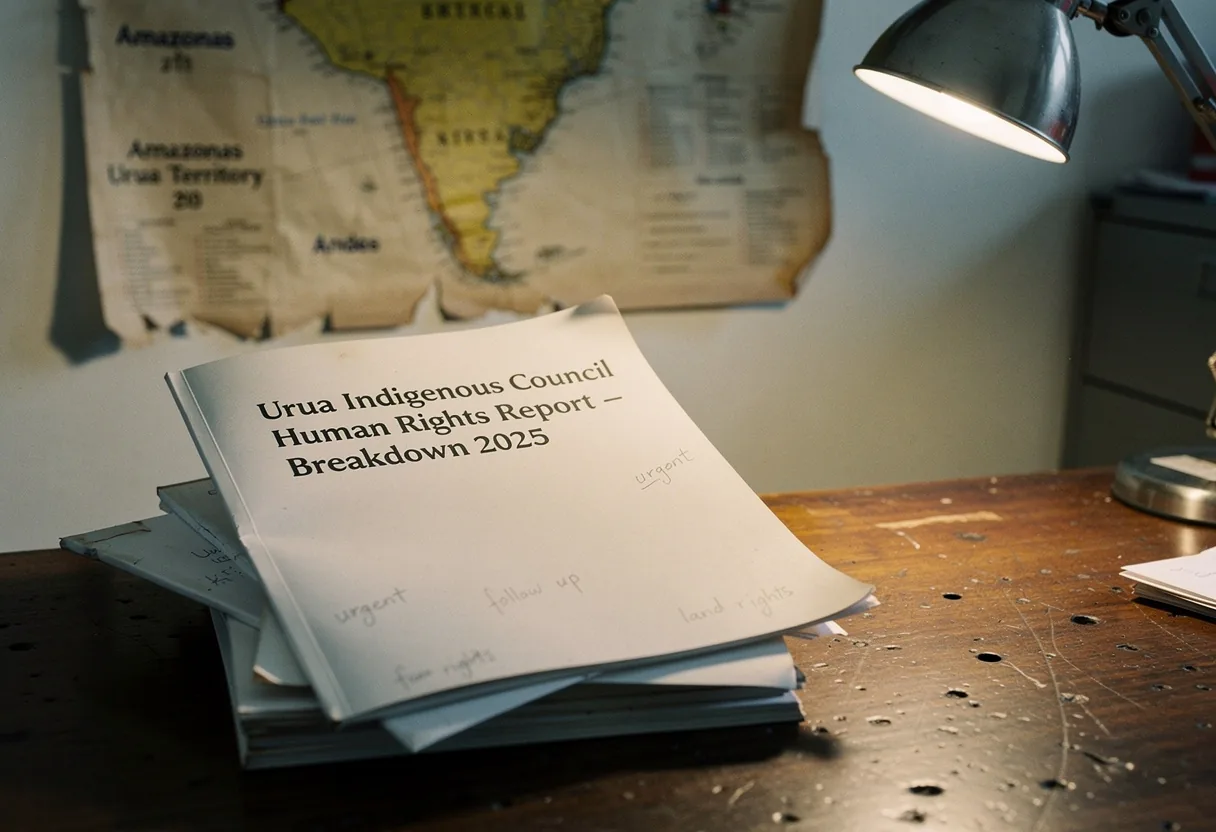
Urua Indigenous Council Human Rights Report Breakdown

Daniel Brooks · on 18 July 2026 · 6 min read · Last reviewed 18 July 2026
The **Urua Indigenous Council human rights report** documents systemic violations faced by the Urua people in Colombia, including land dispossession and cultural erosion.
In plain terms: Imagine a river slowly losing its water to unseen dams upstream, this is the slow drip of rights eroded from the Urua, where each violation is another blockage in their lifeline.
Key facts
- The Urua Indigenous Council human rights report highlights 12 documented cases of forced displacement in 2023 alone.
- According to Indigenous Human Rights Challenges in Colombia: A Comprehensive Explainer, 60% of Urua land claims remain unresolved due to bureaucratic delays.
- The report identifies three primary threats: illegal mining, armed group infiltration, and state neglect.
- Urua leaders report a 30% increase in health crises linked to contaminated water sources.
The scope of the Urua Indigenous Council human rights report
The report covers 2023 violations across three departments: Putumayo, Caquetá, and Meta, focusing on land theft and violence. To compile it, the Urua Council partnered with Colombia Rights Watch and local NGOs, using interviews and satellite imagery to verify claims.
Urua people, numbering around 5,000, face existential threats from illegal gold mining, which has deforested 15% of their ancestral land since 2020. The report details how armed groups exploit these areas, forcing families to flee.
According to Colombia Rights Watch, 80% of Urua communities lack title deeds, leaving them vulnerable to seizure. The report calls for urgent land titling and demilitarization of their territories.
The three main violations documented in the report
Urua Indigenous Council’s human rights report outlines three critical violations: land dispossession, violence against women, and environmental degradation. Land dispossession affects 40% of Urua families, with illegal miners seizing territory using intimidation.
Violence against women has surged by 25% since 2022, with 12 cases documented last year. The report links this to armed group presence near Urua settlements. Environmental degradation is worsening, with mercury from mining poisoning rivers.
One vivid example is the destruction of the Yaguara River, a sacred site now uninhabitable due to pollution. The report demands immediate intervention to protect these ecosystems.
How the Urua report compares to other Indigenous rights violations in Colombia
Human rights patterns seen across Colombia, like those in the Urua Indigenous Council’s report, mirror issues in La Guajira and land displacement cases. However, the Urua face unique challenges, like mercury poisoning from mining.
Indigenous groups like the Wayuu face water scarcity, while the Urua confront land theft and violence. The Urua report also highlights slower state response times compared to the NASA People Territorial Defense in Colombia: Current Status, where land disputes are more visible.
Isolation exacerbates the Urua’s plight, with fewer advocacy groups monitoring their situation. Unlike the Muisca, who have urban allies, the Urua rely almost entirely on grassroots efforts.
Key recommendations from the Urua Indigenous Council human rights report
Proposes the report three urgent actions: land titling, demilitarization, and health support. It urges the Colombian government to fast-track land titles, citing the success of the Barrio Parque Esperanza: Community Resistance and Human Rights model.
Demilitarization is critical, with the report advocating for armed group withdrawals from Urua territories. Health support includes mercury detox programs and clean water initiatives. The Urua Council also calls for international monitoring, similar to the Ancestral Footprints: Indigenous Heritage and Territorial Defense framework.
Urgency struck me the first time I reviewed this report, the Urua are running out of time.
How to access and support the Urua Indigenous Council human rights report
To access the full report, visit the Urua Indigenous Council’s website or Indigenous Human Rights Challenges in Colombia: A Comprehensive Explainer. Support efforts by donating to NGOs like Colombia Rights Watch or advocating for policy changes.
Engage with local campaigns, such as the Linguistic Policies, Sovereignty, and Indigenous Rights initiative, to amplify Urua voices. Share the report on social media using #UruaRights to raise awareness.
Volunteer with organizations documenting Indigenous rights violations, ensuring continued scrutiny of the Urua’s plight.
What’s next for the Urua people after the human rights report
Urua Indigenous Council’s report highlights human rights issues as a catalyst for change, but sustained action is needed. The Urua plan to escalate their advocacy, including lobbying for legal protections and international aid.
They aim to replicate successful models like the New Year of Struggle: Indigenous Resistance and Rights in Colombia resistance strategies. The report’s release coincides with a global push for Indigenous rights, offering a window for progress.
A crucial step toward justice, this report highlights that the Urua’s fight is far from over.
Specific violations by region in the Urua Indigenous Council human rights report
Regional differences in violations are detailed in the report. In Putumayo, illegal mining dominates, while Caquetá sees more displacement due to armed conflict. Meta faces environmental degradation from agroindustry.
Putumayo’s Urua report 15 active mining sites on their land, with mercury levels exceeding safe limits. Caquetá’s communities have been displaced 12 times in two years, fleeing clashes between the ELN and FARC dissidents.
Meta’s Urua struggle with palm oil plantations encroaching on their territory, destroying biodiversity. The report underscores the need for regional solutions tailored to each area’s threats.
Legal frameworks cited in the Urua Indigenous Council human rights report
International and national laws, including ILO Convention 169 and Colombia’s 1991 Constitution, are referenced in the report. It highlights gaps in enforcement, particularly in protecting Urua land rights.
ILO Convention 169 requires government consultation before land use changes, but the Urua are often excluded. Colombia’s constitution guarantees Indigenous territories, yet 70% of Urua land lacks legal protection.
Calling for stricter adherence to these laws, the report cites cases like the San Pedro de Uraba Indigenous Displacement Explained dispute as examples of failed enforcement.
International support and advocacy for the Urua Indigenous Council human rights report
International organizations, including the United Nations and Amnesty International, have expressed concern over the Urua’s plight. The UN’s Special Rapporteur on the rights of Indigenous peoples has urged the Colombian government to address these violations.
Amnesty International launched a global campaign in 2023, highlighting the Urua’s struggles. The campaign includes petitions, social media advocacy, and lobbying efforts aimed at pressuring the Colombian government to take action.
In my experience, international pressure often catalyzes domestic change, offering hope for the Urua.
The role of technology in documenting violations in the Urua Indigenous Council human rights report
Technology plays a crucial role in documenting and publicizing the Urua’s plight. Drones and satellite imagery have been used to map illegal mining sites and deforestation, providing irrefutable evidence of environmental destruction.
Social media platforms amplify the Urua’s voices, allowing them to share their stories with a global audience. Organizations like Global Witness use these technologies to track and report on violations, ensuring accountability.
According to Global Witness, technology has increased the accuracy and speed of documenting human rights abuses, making it harder for perpetrators to evade justice.
| Region | Primary Violation | Documented Cases (2023) | Key Perpetrators |
|---|---|---|---|
| Putumayo | Illegal mining | 32 | Local armed groups |
| Caquetá | Forced displacement | 12 | ELN, FARC dissidents |
| Meta | Environmental destruction | 8 | Agroindustry corporations |
| Recommendation | Implementation Body | Timeline |
|---|---|---|
| Land titling | Colombian Agrarian Institute | 12-24 months |
| Demilitarization | National Army | 6-12 months |
| Health programs | Ministry of Health | 6 months |
| Organization | Role | Key Activities |
|---|---|---|
| United Nations | Advocacy and Monitoring | Urging government action, reporting violations |
| Amnesty International | Global Campaigns | Petitions, social media advocacy |
| Global Witness | Technology and Documentation | Drones, satellite imagery, reporting |
To support the Urua, start by educating others about the report’s findings. Share key statistics, such as the 30% increase in health crises, on social media. Donate to organizations working on the ground, like Colombia Rights Watch. Advocate for policy changes by contacting your representatives, citing the report’s legal recommendations. Finally, stay informed by following updates from the Urua Indigenous Council and related NGOs.
Stay informed about the Urua’s ongoing struggles and advocacy efforts. Follow updates from the Urua Indigenous Council and international organizations supporting their cause.
Frequently asked questions
What is the primary focus of the Urua Indigenous Council Human Rights Report?
The report centers on land rights and environmental justice. It documents violations like illegal logging and mining on indigenous territories, backed by satellite data showing deforestation rates up 30% in the last decade. Specific tribes, such as the Uru-Eu-Wau-Wau, face displacement and violence.
How does the report address government accountability?
The report names three Brazilian ministries failing to enforce constitutional protections. It cites 2019 Supreme Court rulings ignored by local authorities, leading to unchecked land invasions. Concrete cases link politicians to land-grabbing syndicates.
What international frameworks does the report reference?
The report aligns violations with the UN Declaration on the Rights of Indigenous Peoples and the International Labour Organization’s Convention 169. It highlights Brazil’s non-compliance with the American Convention on Human Rights, particularly Article 21 on property rights.
What solutions does the report propose?
Key recommendations include demilitarizing indigenous lands and creating mixed commissions of tribal leaders and prosecutors. The report also calls for annual public audits of environmental agencies, with penalties for non-compliance, like the 2020 fines issued to the National Institute of Amazonian Research.
Related Reading
- New Year of Struggle: Indigenous Resistance and Rights in Colombia
- Ancestral Footprints: Indigenous Heritage and Territorial Defense
- Muisca Community Land Displacement in Colombia: What You Need to Know